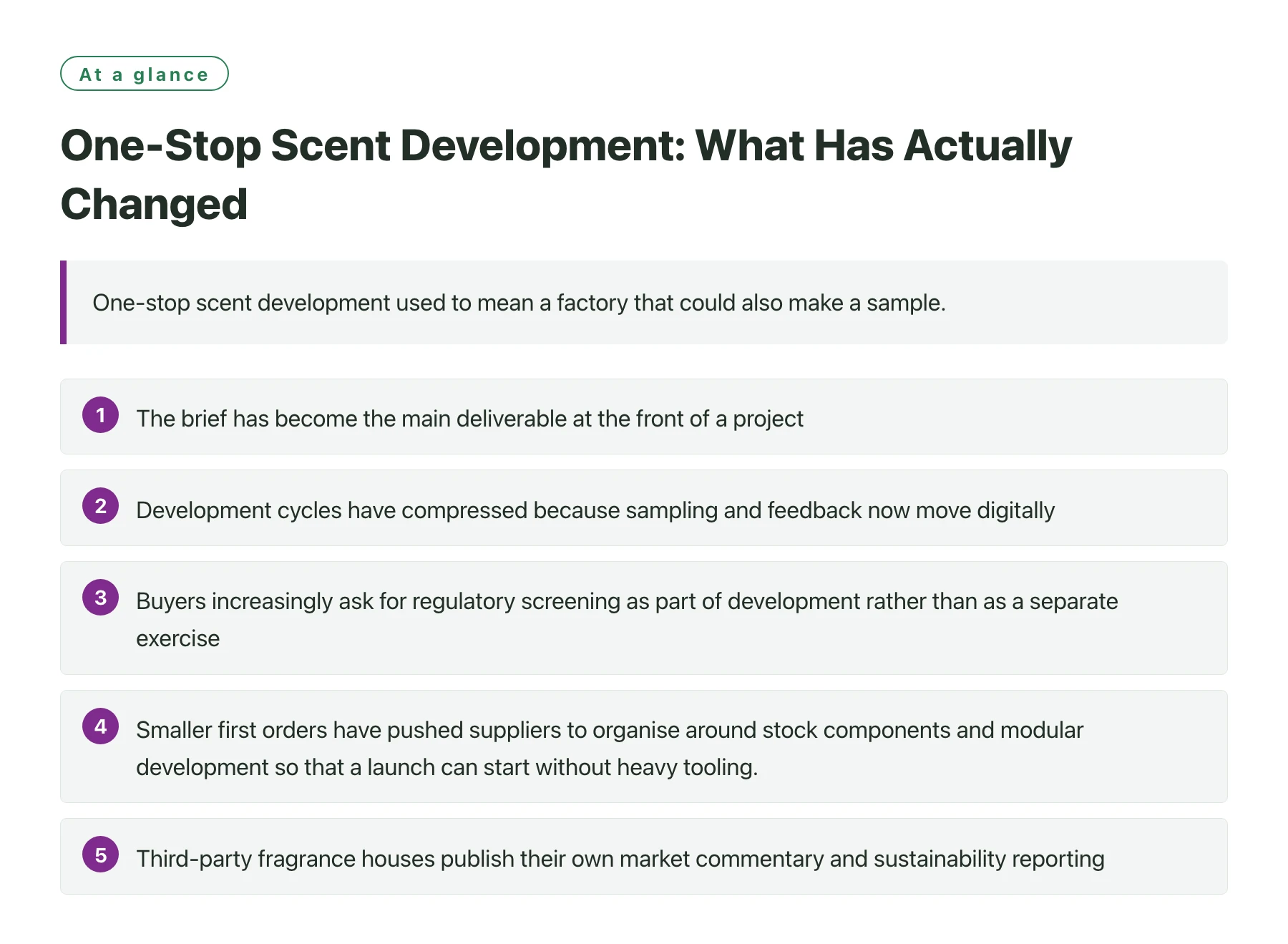
One-stop scent development used to mean a factory that could also make a sample. Today it means something closer to a product development department: brief interpretation, iterative sampling, regulatory screening, packaging fit, documentation and production under one schedule. The shift was driven less by manufacturing technology than by buyers, who now arrive with smaller first orders, shorter windows and more questions about compliance than they did a decade ago.
Key takeaways
- The brief has become the main deliverable at the front of a project; suppliers are judged on how precisely they can interrogate a product idea before development begins.
- Development cycles have compressed because sampling and feedback now move digitally, but the physical stages — resting, stability, compatibility — have not sped up at all.
- Buyers increasingly ask for regulatory screening as part of development rather than as a separate exercise, because a scent that cannot be sold in the target market is not a finished development.
- Smaller first orders have pushed suppliers to organise around stock components and modular development so that a launch can start without heavy tooling.
- Third-party fragrance houses publish their own market commentary and sustainability reporting, which is a useful public read on where the supply base is moving [1].
The phrase one-stop has been used in manufacturing for decades, and it has usually meant co-location: the same site handles development and production, so the brand does not have to ship a formula anywhere. That is still true, and it is no longer the interesting part.
What changed is the amount of thinking that sits before the first sample. A modern development partner is expected to translate a commercial idea — a price point, a retail channel, a customer — into a technical specification, then defend that translation against cost, regulation and the reality of what the packaging can hold.
This article looks at what has actually shifted, and what has stubbornly refused to change.
Then and now, at the point of briefing
| Dimension | A decade ago | Typical today |
|---|---|---|
| Starting point | A reference fragrance, or a note list | A price point, a channel and a competitor set |
| First deliverable | A sample | A written interpretation of the brief, with open questions |
| Iteration | Physical samples by courier, weeks per round | Digital review filters the directions before physical samples |
| Typical first order | Large enough to justify custom tooling | Small, often on stock components |
| Compliance | Checked before launch, often late | Screened during development, market by market |
| Documentation | A certificate on request | A package: batch records, test reports, declarations |
| Who coordinates | The brand chasing several vendors | One partner, or the brand acting as coordinator by choice |
The bottom row explains most of the others. As the number of specialists a project touches has grown, coordination itself has become the thing buyers are shopping for.
Why the front of the project got longer
Ten years ago a brand could send three reference fragrances and ask for something similar. The supplier would sample, the brand would react, and the loop would repeat. That still happens, but the cost of a wrong direction is now higher, because packaging is often developed in parallel and a late change to the scent can invalidate work already done on the pack.
The response has been to invest more time at the brief stage and less in wandering. Suppliers that run development and production together tend to ask the same questions in the first meeting: what is the fill volume, what does the carton cost, which market is this for, and what is the shelf-life expectation. Those questions are not administration. They are the difference between a scent that can be produced at the target price and one that cannot.
Trade coverage of the beauty industry has tracked this consistently: launches are more frequent, ranges are narrower, and the supply base is expected to support both [2]. The commercial consequence is that a development partner is now measured on how quickly it can say no to a direction that will not work.
That measurement only works if the partner can see the whole project. A supplier that keeps R&D and manufacturing in one place can price a brief against its own line records instead of estimating, which is why the front of the project has become the part buyers pay most attention to.
The stages that did not get faster
Resting time after compounding, stability testing and component compatibility testing all measure physical change over time, and no workflow improvement shortens them. Compatibility in particular is a laboratory question rather than a scheduling one — the interaction between a concentrate and a pump, a gasket or a lacquer has to be observed. Analytical chemistry is what converts those observations into a decision, and the methods involved are the same ones used across the chemical industry [3].
The practical implication for a brand is that the calendar should be built around these fixed intervals and everything else should be arranged to fit them, rather than the reverse.
Smaller orders changed how ranges are built
A first order that no longer needs custom tooling changes the shape of a launch. Brands can test two or three directions in market, keep the winner and drop the rest. That flexibility depends on the supplier having modular development — a base that can be adjusted, stock bottles that can be decorated differently, cartons that can be reprinted without new dies.
The trade-off is that a shared starting point can limit differentiation, which is precisely why exclusivity terms deserve attention when the development is modular. Market research publishers maintain a running commentary on how fragrance and beauty consumers are behaving, and the direction they describe favours more frequent, smaller launches rather than fewer large ones [4]. The same modular logic now shapes the R&D process behind wholesale fragrances, where a brief is often built from existing accords before anything bespoke is developed.
A useful question when a supplier describes itself as one-stop: ask which decisions the brand still has to make, and which the supplier takes over. The answer defines the service. Two suppliers can both say one-stop and mean very different things — one means production capacity, the other means product development.
What all of this asks of a manufacturer
Supporting both development models is harder than it sounds, because OEM work assumes the brand brings the technical definition while ODM work assumes the supplier builds it. Running the two in the same organisation means separate workflows, separate documentation habits and staff who can move between them without confusing the two. A manufacturer that a manufacturer that supports OEM and ODM is, in practice, one that has had to standardise how a brief becomes a specification.
The second requirement is transparency about the process itself. When development and production are separate, a brand can inspect each stage with its own eyes and its own people. When they are combined, the brand's visibility comes from documentation instead — which is why the quality of the records, and the willingness to walk a buyer through them, has become a differentiator rather than a formality.
Third, the reference sample has quietly become more important, not less. Faster iteration with more digital filtering means more decisions are made on screens and photographs, and the physical approved sample is the only artefact that survives that. If the bulk order does not match it, the file has to contain something to compare against.
None of this makes one-stop development the right answer for every brand. A brand with a strong internal development capability may prefer to keep formulation in house and buy production only, which is a perfectly coherent strategy. The change in recent years is simply that the decision is now explicit rather than assumed, and suppliers are expected to describe their development workflow in enough detail for the brand to choose. Buyers who ask for that description before briefing tend to end up with fewer surprises, and the same conversations about scope, ownership and documentation that used to happen at contract stage now happen at the first meeting.
Sources
- Givaudan —— One of the largest fragrance and flavour houses; public material on fragrance creation, ingredient portfolio and market segments.
- Cosmetics Business —— A trade publication covering the beauty and cosmetics industry, including fragrance launches and regulatory developments.
- Chemistry World (Royal Society of Chemistry) —— The Royal Society of Chemistry's magazine, covering chemistry research and explanations of everyday materials including aroma compounds.
- Mintel Press Centre —— Mintel's press releases on consumer and beauty market research, including fragrance and personal care trend reporting.
Frequently asked questions
What does one-stop fragrance development include?
At minimum, brief interpretation, sampling and iteration, and production of the finished product. In practice the useful definition is broader: regulatory screening, packaging fit and documentation. The scope should be written down, because two suppliers using the same phrase may include very different things.
Has development really become faster?
The decision loop has become faster because review is digital and directions can be filtered before physical samples are made. The physical stages — resting, stability, compatibility testing — have not changed, so the total calendar saving is smaller than the improvement in communication suggests.
Is one-stop always cheaper?
Not necessarily. Consolidation usually reduces coordination cost and schedule risk, while a split supply chain can be cheaper at high volume. The comparison should include the cost of the brand's own coordination time, which is often the largest hidden item.
How should a brief change if the supplier handles development too?
It should describe the commercial outcome rather than a note list: price point, channel, target market, fill volume, shelf-life expectation and any competitor reference. A supplier doing development needs the constraints, not only the smell.
Does a smaller first order mean lower quality?
No, but it usually means stock components and a modular approach rather than bespoke tooling. Quality is determined by specification and process control; the size of the run mainly changes which packaging options are economic.