Okoume Faces for Decorative Cabinetry and Wall Panels
Okoume is chosen for the colour it brings into a room before anything else. The face veneer runs from pale red to a pinkish tone with a uniform grain structure, which is why it turns up in cabinetry, wall cladding and joinery that will be finished with a clear sealer rather than covered. It is also a relatively light panel for a hardwood face, which makes it easier to handle on site — a combination that explains its place in marine interiors as well as in hotel fit-outs.
Key takeaways
- Judge the face first: a natural Okoume veneer in pale red to pink reads differently under daylight, lamp light and clear sealer.
- Low density is a working advantage — lighter panels are easier to lift, fix and keep dimensionally stable in tall cladding runs.
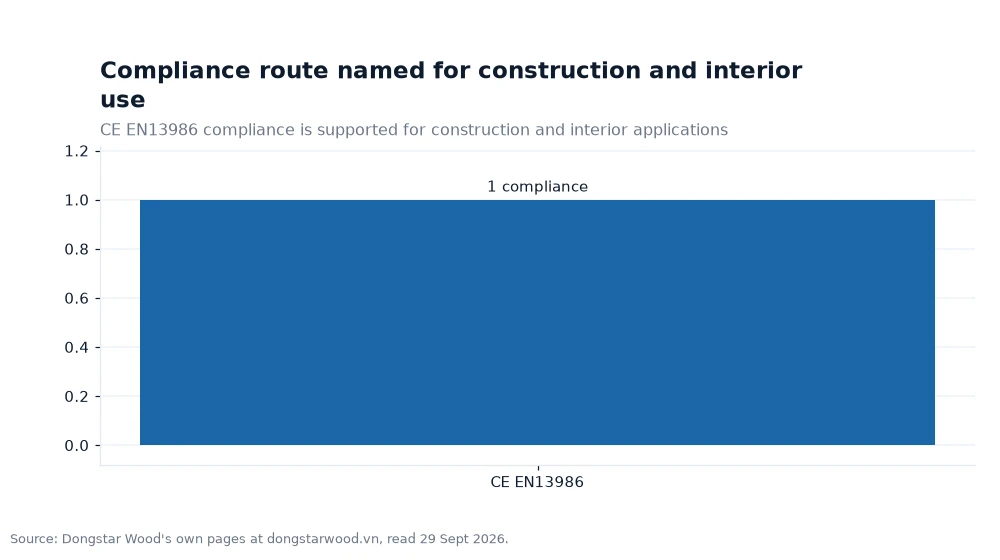
- Check the compliance route early: CE EN13986 is the standard commonly supported for construction and interior applications.
- Emission grades E1 and E0 belong on the order alongside the face grade when panels are used indoors.
Why the face colour drives the specification
An Okoume face is rarely painted over, which turns colour into a structural part of the brief. The veneer is natural and uniform in grain, running from pale red through pinkish tones, and designers select it precisely because that warmth shows through a clear finish. Get the face grade wrong and the mistake is visible in every panel of a wall run, so the sample stage matters more here than with a painted sheet.
Uniformity is the second requirement. A wall clad in adjacent panels is judged as a single surface, and a batch that shifts tone halfway across the run reads as two different rooms. Ask for the panels for one elevation to come from the same batch, and treat the sample as a reference you keep rather than a curiosity you file.
| Application | Where it fits | What to confirm on the order |
|---|---|---|
| Cabinetry and wardrobes | Chairs, tables, cabinets, fitted units | Face grade and edge treatment |
| Wall cladding and ceilings | Interior panelling, ceiling panels | Batch consistency across one elevation |
| Doors and joinery | Doors, trims, decorative accents | Machining quality and surface flatness |
| Marine interiors | Yacht cabinetry and boat interiors | Glue class and moisture exposure |
| Light structural work | Lightweight structural elements | Load path and fixing detail |
What low density buys on site
Okoume is described as relatively low in density compared with many hardwood plywoods, and that has practical consequences beyond the weighbridge. Lighter sheets are easier to lift into position on a ceiling or a high wall, easier for one fitter to handle, and more forgiving for the fixings that hold cladding to a frame. Dimensional stability comes with the same package: a panel that moves less under humidity is a panel whose joints stay closed.
Where marine interiors are involved, low weight is worth more still. Every kilogram saved in cabinetry is a kilogram the hull does not carry, which is why pale-faced Okoume finds its way into yacht fit-out alongside the more strictly structural materials.
Finishing schedules that suit a uniform grain
The surface is calibrated and pressed to a tight thickness tolerance, which is what makes it suitable for finishing or lamination rather than left raw. Paints, stains, laminates and clear sealers are all named as compatible finishes, and each one asks something different of the face: a stain reveals grain variation, a laminate hides it entirely, and a clear sealer does neither — it simply holds the natural colour where the customer can see it.
Test the finish on the panel, not on a swatch. Because the veneer is natural, the same sealer can read differently on two sheets from different batches, and a finishing trial on production panels saves a rework claim later on.
Worked example: cladding one wall in okoume panels
Take a reception wall of 6 m long and 2.7 m high: 6 m × 2.7 m = 16.2 m² of finished surface. Using a 1250 × 2500 mm sheet as an example layout — 3.125 m² (1.25 × 2.5 m) — the wall needs 16.2 ÷ 3.125 = 5.18, so six sheets, with the last one cut down for the return. Add the usual 10% for cutting and edge trim and the order becomes seven sheets, which leaves a spare panel from the same batch for repairs.
Ceilings follow the same sum with a different waste factor. A 12 m × 4 m ceiling is 48 m², or 48 ÷ 3.125 = 15.36 panels, so sixteen sheets plus two for waste. Ordering the spare sheets from the same batch matters more than the spare itself: a later delivery in a slightly different tone shows up immediately on a ceiling.
Compliance: CE EN13986 and low-emission glues
An Okoume Plywood Supplier that has documented this route is easier to shortlist, because the compliance conversation can start from a standard rather than from a claim. For construction and interior work, the compliance route named across the range is CE EN13986, supported for panels used in both settings. That is the document a specifier usually asks for first, and it sits alongside low-emission glue systems rather than replacing them: E1 and E0 classes describe what the finished panel releases indoors, while CE addresses the standard the panel is assessed against for its application.
The distinction matters in a hotel or office project where both questions are asked by different people. An interior designer will want the emission grade, and a contractor's technical submission will want the CE reference. Both can be answered from the same product page, but only if the buyer requests them as two separate items.
Marine interiors and light structural work
Okoume's other home is the water. The published applications list marine interiors and light construction, including yacht cabinetry, boat interiors and lightweight structural elements, and the reasoning is straightforward: a stable, relatively light panel with a face worth looking at suits a cabin far better than a heavier sheet that has to be covered. Where the timber comes from is part of that story too — the species is native to Africa and sourced from sustainably harvested Okoume timber.
For a boatyard, the specification questions are the same as on land, just with tighter margins: glue class for humidity, thickness tolerance for a flush fit, and a face grade that can take a varnish schedule without showing every sanding mark.
Frequently asked questions
Is Okoume suitable for exterior cladding?
It is normally specified for interior panelling, cabinetry, joinery and marine interiors rather than for permanent external exposure. Where panels are used in marine settings, the relevant question is not the face but the glue class and how the panel is protected and ventilated.
How does Okoume compare with a birch face for cabinetry?
The difference is tone and density rather than quality. Birch faces run from light cream to pale brown and take stain and laminate evenly, while Okoume brings a pale red to pink natural colour with a uniform grain. Weight is the second factor, since Okoume is a relatively low-density hardwood panel.
Which emission grade should an indoor fit-out specify?
Low-emission glue systems are available in E1 and E0 classes across the range, and the choice depends on the project's own air-quality requirement. Ask for the grade in writing alongside the CE EN13986 documentation so the two are quoted together.
Selecting face grade, batch and thickness
Put four lines on the order: face grade, batch for each elevation, finish schedule and compliance documents. Designers specifying a mixed palette often compare the wider panel catalogue for painted and laminated areas, and workshops that need a cooler, more neutral face for furniture carcasses usually price the birch-faced panels beside the Okoume option before deciding which rooms get which finish.
The face description, application list and compliance wording quoted here follow the manufacturer's site, viewed on 29 September 2026 as referenced in these notes as referenced in these notes for the numbers in this article[1].