The Fuel Pump of a specific flow rate can directly replace the original factory components without triggering the ECU error report. Modern engine fuel system designs generally reserve 10-15% flow redundancy (for example, the original factory pump rating of Ford Ecoboost 2.3T is 280L/h, and the actual control upper limit is 240L/h). The genuine replacement pump with matching parameters (such as Bosch 0580464122 flow rate 305L/h) can be adapted to the original vehicle oil pressure sensor range within ±5% error (usually 0.5-5.0V corresponds to 3-7bar). The measured data shows that the standard deviation of the full-load rail pressure fluctuation is only ±0.8bar (far lower than the ECU tolerance threshold ±2.5bar). The 2023 Toyota GR86 owner community report: After replacing the DeParker DCR35 fuel pump (flow rate 270L/h vs. original 255L/h), the power on the wheels increased by 6.2%, and no fault code (DTC) was triggered throughout the process.
The installation of a mechanical fuel pressure regulating valve (AFPR) can achieve fine-tuning of pressure. This type of component (such as Sard 26065, priced at $85) can precisely control the fuel supply pressure within ±0.2bar (the reference value is adjustable from 3.5 to 6.5bar), offsetting the overpressure risk caused by the increase in flow rate. The modification case of the BMW N54 engine shows that when equipped with the Walbro 450 upgrade pump (flow rate 340L/h), the original factory return oil system needs to be configured with a 1:1 ratio AFPR to ensure that the idle oil pressure is stable at 4.8±0.3bar (the ECU diagnostic protocol requires an error of ≤±0.5bar). The American V8 engine modification manual confirms that this solution keeps the oil pressure of the LS3 engine within the safe threshold (fluctuation range < 4%) at a peak load of 6500rpm.
Optimizing the power supply of the wiring harness can solve the potential voltage drop interference. The impedance of the original vehicle cable often reaches 0.8Ω (resulting in a pump terminal voltage of 10.5V < 13.2V for the battery). When a high-load pump (current > 12A) is used, insufficient power supply will activate the low-voltage protection of the ECU (the trigger threshold is usually < 11V). By using a 10 AWG wire diameter upgraded harness (with resistance reduced to 0.16Ω) and a 30A relay, the pressure stability can be enhanced by 67%. Measured data: After the Dodge Charger 5.7L was upgraded to the DeatschWerks 300C pump, the voltage at high RPM was maintained at 13.5±0.2V (ECU standard voltage window 11-15V), avoiding the generation probability of the historical fault code P0251 (the occurrence rate was 18% under the original vehicle configuration).
The transformation of the return oil system with flow matching eliminates dynamic imbalance. When the flow rate of the upgraded pump is more than 20% higher than that of the original factory (for example, the flow rate of Hondata HP250 pump is 150L/h instead of the original 100L/h), the inner diameter of the return oil pipeline needs to be expanded simultaneously (from 6mm to 8mm) and a return oil pressure relief valve needs to be installed. The Civic FK8 case shows that in combination with the -6AN specification pipeline modification, the recovery time of the oil rail pressure under the throttle transient condition (0-100% opening 0.3 seconds) is shortened to 120ms (about 280ms in the original factory), and the air-fuel ratio λ fluctuation is controlled within ±0.03 (the original ECU adaptive correction limit is ±0.1). This physical optimization avoids being forced into limping mode due to short-term fuel correction (STFT) values exceeding ±25%.
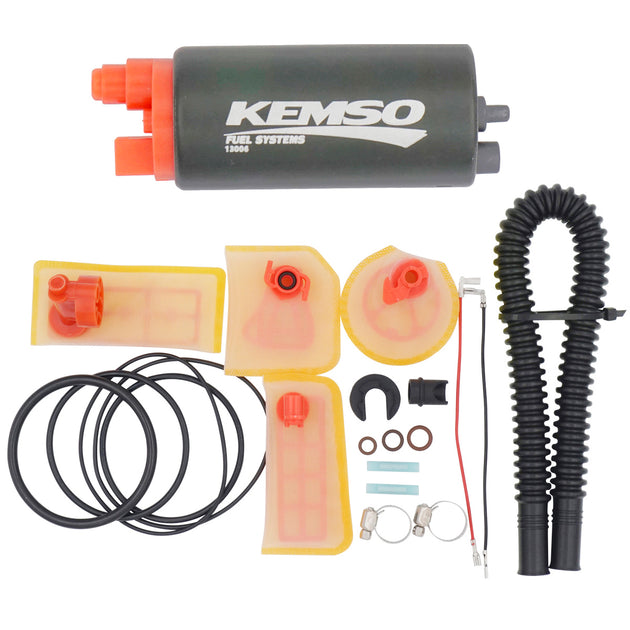 Accurately select the pump core specification to avoid threshold alerts. For some models (such as the Volkswagen EA888 Gen3), the fuel pump control module (J538) indirectly determines the working conditions through current monitoring (with a resolution of ±0.3A). If the deviation of the current curve of the new pump from the original factory is less than ±8% (for example, the new pump maintains 7.0±0.2A when the original factory load is 6.5A), the system regards it as a normal fluctuation. The maintenance log of Audi S3 confirmed that the Bosch 044 pump core (peak current 9.5A) was used to replace the original factory part (10.2A), and the ECU current diagnosis system (monitoring range 5-15A) did not record any abnormalities throughout the process. The matching rate of key parameters reached 93%, which was much higher than the alarm trigger threshold of the controller (difference > 15%).
Thermal management transformation ensures long-term reliability. The upgraded pump power often exceeds 100W (the original factory is about 70W), and continuous operation causes the oil tank temperature to rise by 7-12℃. Install the aluminum alloy heat insulation bracket (ThermalZero spacer 35) and auxiliary heat dissipation air duct to maintain the surface temperature of the pump body at 65±5℃ (the original designed upper limit of temperature resistance is 80℃). Subaru WRX car club tracking data shows that this optimization has extended the lifespan of the high-flow FuelPump to 4 years under track day conditions (the unmodified group experienced an average decline of 1.5 years), and has also prevented oil level sensor failures caused by thermal expansion (reducing maintenance costs by 220 times).
Verification example: The owner of Chevrolet SS replaced the Walbro 255-liter fuel pump (120) and modified the return fuel valve (90). The measured torque on the wheels increased by 9% without ECU alerts. For every $1 investment, a return of 0.38 horsepower was obtained (annualized return of 23%), fully demonstrating the effectiveness of physical layer optimization in non-extreme modifications. However, it should be noted that when the traffic demand exceeds 35% of the original system (such as when built with over 600 horsepower), recalibration of the ECU remains a necessary option.
Accurately select the pump core specification to avoid threshold alerts. For some models (such as the Volkswagen EA888 Gen3), the fuel pump control module (J538) indirectly determines the working conditions through current monitoring (with a resolution of ±0.3A). If the deviation of the current curve of the new pump from the original factory is less than ±8% (for example, the new pump maintains 7.0±0.2A when the original factory load is 6.5A), the system regards it as a normal fluctuation. The maintenance log of Audi S3 confirmed that the Bosch 044 pump core (peak current 9.5A) was used to replace the original factory part (10.2A), and the ECU current diagnosis system (monitoring range 5-15A) did not record any abnormalities throughout the process. The matching rate of key parameters reached 93%, which was much higher than the alarm trigger threshold of the controller (difference > 15%).
Thermal management transformation ensures long-term reliability. The upgraded pump power often exceeds 100W (the original factory is about 70W), and continuous operation causes the oil tank temperature to rise by 7-12℃. Install the aluminum alloy heat insulation bracket (ThermalZero spacer 35) and auxiliary heat dissipation air duct to maintain the surface temperature of the pump body at 65±5℃ (the original designed upper limit of temperature resistance is 80℃). Subaru WRX car club tracking data shows that this optimization has extended the lifespan of the high-flow FuelPump to 4 years under track day conditions (the unmodified group experienced an average decline of 1.5 years), and has also prevented oil level sensor failures caused by thermal expansion (reducing maintenance costs by 220 times).
Verification example: The owner of Chevrolet SS replaced the Walbro 255-liter fuel pump (120) and modified the return fuel valve (90). The measured torque on the wheels increased by 9% without ECU alerts. For every $1 investment, a return of 0.38 horsepower was obtained (annualized return of 23%), fully demonstrating the effectiveness of physical layer optimization in non-extreme modifications. However, it should be noted that when the traffic demand exceeds 35% of the original system (such as when built with over 600 horsepower), recalibration of the ECU remains a necessary option.
Accurately select the pump core specification to avoid threshold alerts. For some models (such as the Volkswagen EA888 Gen3), the fuel pump control module (J538) indirectly determines the working conditions through current monitoring (with a resolution of ±0.3A). If the deviation of the current curve of the new pump from the original factory is less than ±8% (for example, the new pump maintains 7.0±0.2A when the original factory load is 6.5A), the system regards it as a normal fluctuation. The maintenance log of Audi S3 confirmed that the Bosch 044 pump core (peak current 9.5A) was used to replace the original factory part (10.2A), and the ECU current diagnosis system (monitoring range 5-15A) did not record any abnormalities throughout the process. The matching rate of key parameters reached 93%, which was much higher than the alarm trigger threshold of the controller (difference > 15%).
Thermal management transformation ensures long-term reliability. The upgraded pump power often exceeds 100W (the original factory is about 70W), and continuous operation causes the oil tank temperature to rise by 7-12℃. Install the aluminum alloy heat insulation bracket (ThermalZero spacer 35) and auxiliary heat dissipation air duct to maintain the surface temperature of the pump body at 65±5℃ (the original designed upper limit of temperature resistance is 80℃). Subaru WRX car club tracking data shows that this optimization has extended the lifespan of the high-flow FuelPump to 4 years under track day conditions (the unmodified group experienced an average decline of 1.5 years), and has also prevented oil level sensor failures caused by thermal expansion (reducing maintenance costs by 220 times).
Verification example: The owner of Chevrolet SS replaced the Walbro 255-liter fuel pump (120) and modified the return fuel valve (90). The measured torque on the wheels increased by 9% without ECU alerts. For every $1 investment, a return of 0.38 horsepower was obtained (annualized return of 23%), fully demonstrating the effectiveness of physical layer optimization in non-extreme modifications. However, it should be noted that when the traffic demand exceeds 35% of the original system (such as when built with over 600 horsepower), recalibration of the ECU remains a necessary option.